Geometry-based simulation of self assembly
We develop geometric approaches to understand how solvent-mediated interactions shape the structure and assembly of complex systems. A central methodological theme is the use of coarse-grained models combined with morphometric descriptions of solvation, allowing solvent effects to be captured through geometric measures rather than detailed microscopic simulations. We analyse how entropic forces arising from the surrounding liquid environment constrain the conformations of flexible biopolymers and drive the organisation of particulate systems. By focusing on geometry, we reveal how solvent structure can stabilize helical folds, influence polymer topology, and promote nontrivial collective assembly. This unified methodology highlights how solvent-induced entropic interactions can be systematically described through geometric principles, providing a transferable framework for studying self-organization across biological and soft-matter systems.
Related article: Complex forms from simple building blocks
Related papers
Topological potentials guiding protein self-assembly
Can solvents tie knots? Helical folds of biopolymers in liquid environments
Solvation, geometry, and assembly of the tobacco mosaic virus
Exotic self-assembly of hard spheres in a morphometric solvent
Periodic entanglements
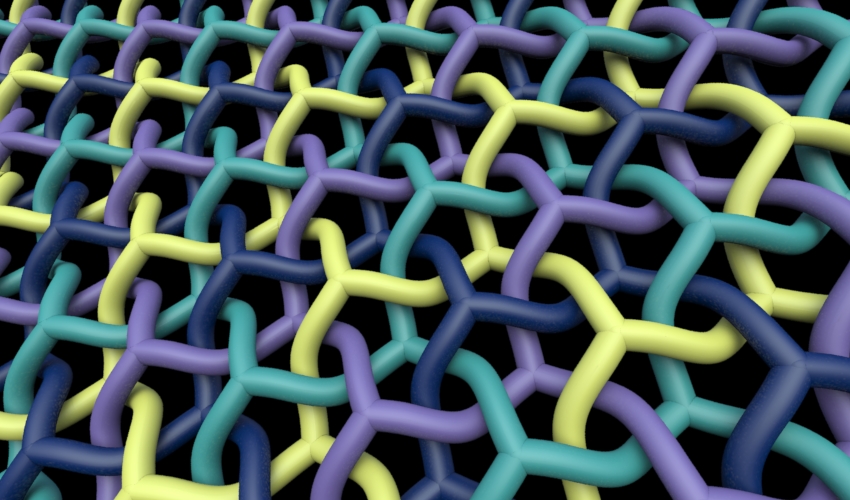
We study the many facets of periodic entanglements found in various biological, molecular, and chemical structures like polymers, liquid crystals, and DNA origami. We use techniques from geometry, topology, combinatorics and graph theory to enumerate and characterise potential structures, in many cases using periodic graphs or triply-periodic minimal surfaces as scaffolds for the structures. In this case, tangling, graphs and surfaces are all related objects of study. On the other hand, we are also developing techniques for the characterisation of these structures, where we look at crossing diagrams and related invariants.
Related article: Complexity explained: Symmetric Tangling of Honeycomb Networks
Related papers
Measuring the entanglement complexity of 3-periodic networks through the untangling number
The untangling number of 3-periodic tangles
Diagrammatic representations of 3-periodic entanglements
Ideal geometry of periodic entanglements
Periodic entanglement III: tangled degree-3 finite and layer net intergrowths from rare forests
Periodic entanglement II: weavings from hyperbolic line patterns
Periodic entanglement I: nets from hyperbolic reticulations
Topological Data Analysis, Theory and Applications
In this group, we work on both aspects of topological data analysis. On the theoretical side, we develop tools in computational geometry, such as stability results for geometric structures and new ways to measure distances between datasets. On the applied side, we apply TDA to complicated materials and systems. For example, we have worked with fibrous materials and entangled pancreatic networks. We also use TDA to guide the assembly of proteins and to study dynamic structure characterisation. We are interested in expanding these methods to other complex systems.
Related papers
Topological Analysis of Multi-Network Threading in the Pancreas
Topological potentials guiding protein self-assembly
The medial axis of any closed bounded set is locally Lipschitz stable with respect to the Hausdorff distance under ambient diffeomorphisms
Bregman–Hausdorff Divergence: Strengthening the Connections Between Computational Geometry and Machine Learning
Cocoon microstructures through the lens of topological persistence
Framework materials and tensegrity structures
Framework materials can be understood as an embedded graph with edge-length constraints. Introducing an energy functional by adding contracting (cables) and expansive edges (struts) to this framework makes it a tensegrity (tensile integrity). This physical system can be modeled as a polynomial optimization problem, making related numerical strategies feasible.
We can tackle the modeling and equilibration of complicated real-world structures such as cylinder packings by developing a robust and general-purpose Riemannian optimization package based on homotopy continuation in combination with a geometric model for the contact between two filaments in tight contact based on tensegrities. This approach allows us to explore these structures’ deformative mechanisms, occasionally revealing an unexpected dilatant property known as auxeticity.
Related papers
Computing Euclidean distance and maximum likelihood retraction maps for constrained optimization
Robust geometric modeling of 3-periodic tensegrity frameworks using Riemannian optimization
Reentrant tensegrity: A three-periodic, chiral, tensegrity structure that is auxetic
Geometric auxetics
Drittmittelförderung
Wir sind Teil der folgenden, größeren Projekte in der Berliner Umgebung und in Deutschland: